

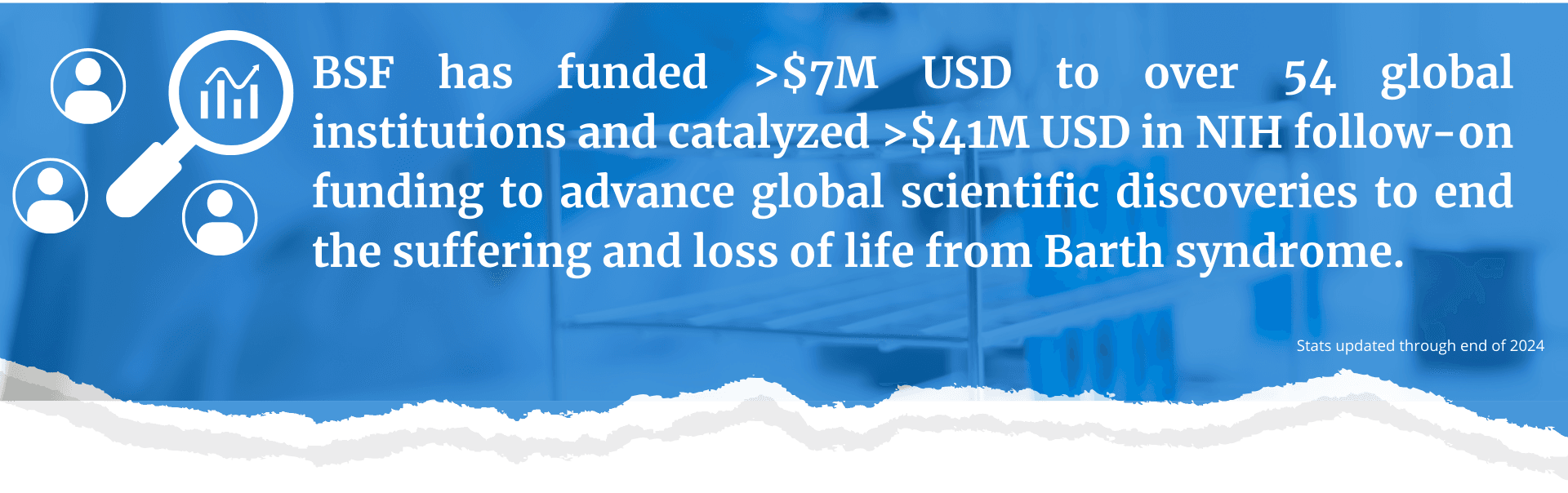
The BSF research grant program seeks to provide seed funding to young and established investigators in order to generate the preliminary data required for successful follow-on funding available from larger institutions.
Vetted by BSF’s Scientific and Medical Advisory Board (SMAB) and external subject-matter experts, grantees demonstrate BSF's unrelenting commitment to identifying potential treatments and better understanding the challenges experienced by our community of affected individuals.
We also host distinct awards for exceptional research. You can read more about the Varner Award here and the Iris L. Gonzalez Prize here.
2026 GRANT AWARDS

Novel ABHD18 inhibitor to treat Barth Syndrome
Timothy Cardozo, MD, PhD | New York University | $100,000 over 3 years
Dr. Cardozo’s team recently identified ABHD18, a potential therapeutic target for Barth syndrome. In this project, they will take the first steps to establish steps for discovering candidate drugs that can inhibit ABHD18. The team will do the following: 1) use advanced computer programs, knowledge of the ABHD18 structure and large chemical libraries to identify drugs that are most likely to bind and inhibit ABHD18; 2) create a test tube experiment that allows us to test the top candidate chemicals; 3) ensure the top candidates are safe and non-toxic and last long enough in the body to have the desired effect. Based on their prior projects like this, they expect to find a drug that can be tested in an animal model of Barth syndrome. Successful achievement of this grant would result in the identification of a drug candidate ready for preclinical and clinical evaluation.
This co-funded project was made possible by a generous contribution from our affiliate Association Syndrome de Barth France.

Gut Microbiota and Metabolites in Barth Syndrome: Potential Mechanistic Links to Feeding and Gastrointestinal Dysfunction
W. Todd Cade, PT, PhD, FAPTA | $70,752 over 1 year | Duke University
Many children and adults with Barth syndrome have serious difficulties with eating and digestion. These issues typically start early in life and include food refusal, vomiting, and sensitivity to textures and smells. Despite how common these problems are, scientists don’t fully understand why they happen. Recent research suggests that the gut microbiome—the community of bacteria living in our intestines—might play a role as these bacteria help us digest food and produce important nutrients. There is also evidence that the mitochondria, which are parts of our cells that produce energy, may interact with gut bacteria in ways that affect health. This project will study the gut microbiome in individuals with Barth syndrome. To do this, the research team will collect stool samples from affected individuals and from healthy relatives as well as information about diet and eating habits and behaviors. This information will be used to analyze the types of bacteria and a byproduct called short-chain fatty acids (SCFAs) which can affect appetite, digestion, and inflammation.
The study will ask three main questions: (1) Are the gut bacteria different in people with Barth syndrome compared to healthy people? (2) Do certain bacteria relate to how severe the eating and stomach problems are? (3) Are the SCFA levels different, and do they affect symptoms?
The expected outcome is a better understanding of how gut bacteria and their chemical products contribute to feeding and digestive problems in Barth syndrome. This could lead to new treatments, such as special diets or probiotics, that improve gut health and reduce symptoms. Ultimately, the goal is to help individuals with Barth syndrome eat better, grow stronger, and feel more comfortable.
This co-funded project was made possible by a generous contribution from our affiliates Barth Syndrome Foundation of Canada and Barth Syndrome UK.

Regulation of cardiolipin metabolism by the mitochondrial phospholipase A1
Itay Budin, PhD | $75,000 over 2 years | University of California San Diego
Loss of TAFAZZIN in Barth syndrome patients causes a loss of cardiolipin, a critical fat in specialized structures within cells called mitochondria, which are responsible for making cellular energy. Without TAFAZZIN, mitochondria to lose their capacity to power cells in energy-demanding tissues like the heart. One potential way to offset these effects is to target alternative enzymes that change the levels of cardiolipin. This project will test if an enzyme called DDHD1, which breaks down lipids, is one such factor. The project will then test if DDHD1 can rescue cardiolipin in TAFAZZIN-deficient cells and define its role in mitochondria. In doing so, the team will determine if this enzyme is a potential target for the development of small molecules that can help increase cardiolipin levels in Barth syndrome patients.
This co-funded project was made possible by a generous contribution from our affiliate Barth Italia.
2025 GRANT AWARDS

In vivo POC of an ABHD18-targeted ASO in TAZ knock-out mice
Vincent Blomen, PhD, Scenic Biotech
2025 Award $100,000, over one year
Dr. Blomen works at Scenic Biotech, an Amsterdam-based biotech company that develops modifier therapies: therapies that target genes other than the disease-causing gene, to alter how a disease develops. His work uses a unique technology platform, the Cell-Seq platform, which led to the discovery of a gene called ABHD18. This gene is involved in processing fats called cardiolipins. Their studies showed that blocking ABHD18 can repair many of the problems seen in cells affected by Barth syndrome. In mice engineered to mimic Barth syndrome with a Tafazzin mutation, but lacking ABHD18, there was no development of heart problems typically seen in the disease.
The team is now developing and evaluating a new type of medicine called antisense oligonucleotide (ASO). ASOs are like little codes that tell cells to stop producing specific proteins, in this case ABHD18. The team will design and test different ASOs in lab-grown cells to find the ones that block ABHD18 most effectively. The best candidates will then be made in larger amounts and tested further. Finally, the most promising ASO will be tested in mice with Barth syndrome to see if repeated treatment can improve heart health and normalize cardiolipin levels, compared to control mice that do have Barth syndrome but do not receive the ASO treatments.
The ultimate goal of this research is to see whether an ASO drug can reduce ABHD18 levels and reverse the symptoms of Barth syndrome.
This co-funded project was made possible by a generous contribution from our affiliate Association Syndrome de Barth France.

Evaluation of ABHD18 as a target to correct TAFAZZIN mutant phenotypes
Jason Moffat, PhD, The Hospital for Sick Children
2025 Award $80,000, over two years
In a previous collaboration and through BSF seed funding, Dr. Moffat's group identified ABHD18 as a potentially important regulator that works upstream of TAFAZZIN, the gene mutated in Barth syndrome. In cell and animal models of Barth syndrome, Dr. Moffat's group and his collaborators showed that perturbing ABHD18 function prevented the symptoms associated with Barth syndrome. In this grant, Dr. Moffat proposes to evaluate a class of drug called a small molecule inhibitor that would be designed to specifically block the activities of ABHD18. In this study, the applicant will see if small molecules can effectively block ABHD18 as a potential therapy for Barth syndrome.
This co-funded project was made possible by generous contributions from our affiliates Barth Syndrome Foundation of Canada, Barth Syndrome UK, and Barth Italia.

Role of p53 Pathway in Barth Syndrome patient-Tailored Mouse Allele
Simon Conway, PhD, Indiana University
2025 Award $80,000, over two years
Dr. Conway’s work focuses on a new mouse model of Barth syndrome. This model is unique because it has the same mutation as an individual with Barth syndrome. While this is not the first “patient-specific” mouse, this model is special because the mutation studied impacts Tafazzin’s enzyme activity without preventing Tafazzin protein from being made. This can be thought of as a hybrid car without gasoline where some parts of the car would still work even in the absence of gas. Similarly, this mutation allows us to learn about jobs TAFAZZIN does outside of being an enzyme. Dr. Conway will use mice to evaluate the relationship between this Tafazzin mutation and the p53 pathway, which was shown in their preliminary data to go from high to low as the mice get older. To study this, hearts from the new Tafazzin patient-tailored mice will be evaluated during embryonic development and right after birth for p53 expression through several different approaches. The grant proposal will also evaluate how loss of Tafazzin function causes the observed changes in p53. Dr. Conway will also look at how mutations in p53 impact the TAFAZZIN mutants by crossing the new mice with a p53 mutant line.
The goal of this research is to uncover novel signaling pathways that are implicated in Barth syndrome, which might allow for new avenues in drug development and better understanding of Barth syndrome in affected individuals where TAFAZZIN protein is made but isn’t functional.
2024 GRANT AWARDS

Cardiac and Skeletal Muscle Myofilament Activators for the Treatment of Barth syndrome
Leonardo Ferreira, PhD, Duke University
2024 Development Award, $99,519, over two years
Barth syndrome (BTHS) causes muscle weakness, fatigue, and difficulty with exercise. Currently, there are no approved treatments for these symptoms. Past research has shown that the ability of the heart and muscles to contract is greatly reduced in patients with BTHS. While it’s generally believed that these issues are due to a lack of energy in the cells, some researchers think that problems with special ions like calcium or cellular engines that generate force could also be contributing to the muscle issues. Most attempts to treat BTHS have focused on improving how cells make energy. However, this project proposes to improve the muscles’ ability to contract or squeeze, which could help with the energy issue and provide additional benefits. Recently, certain small molecules (and potential drug compounds) called “muscle activators” have been found to improve heart contraction and exercise tolerance in patients with heart failure not related to BTHS. These activators have also been shown to increase muscle strength and endurance in animal models and human studies. Importantly, unlike some other treatments, they improve muscle contraction without negatively affecting the cells’ energy production. The Ferreira lab proposes to study these muscle activators in a mouse model of BTHS. They will compare four groups of mice: normal mice, BTHS mice given a placebo, BTHS mice given a skeletal muscle activator, and BTHS mice given a cardiac muscle activator. The main study outcomes will be exercise capacity, heart function, muscle contraction force, and power. This approach is innovative because it targets the muscle contraction mechanism, rather than the cellular energy production. Previous treatments that focused on energy production have been successful in animals but have failed in clinical trials. The researchers hope that this new approach might help to alleviate the heart and muscle problems in BTHS.

Mechanism of cardiolipin remodeling by TAFAZZIN
David Stokes, PhD, New York University
2024 Development Award, $75,000 over two years
Barth Syndrome results from a defect in TAFAZZIN, which is a protein in mitochondria responsible for producing a special lipid called cardiolipin. When TAFAZZIN is defective, abnormal forms of cardiolipin are produced, the morphology of mitochondria is severely disrupted, and protein complexes responsible for making cellular energy are not able to assemble, giving rise to the symptoms that underly Barth syndrome. Despite this general understanding how Barth syndrome occurs, we lack fundamental understanding about the structure and function of TAFAZZIN. This project aims to develop a better understanding of this protein molecule. We propose to use a form of imaging called electron microscopy to take pictures of TAFAZZIN in order to evaluate its architecture, its interaction with cardiolipin, and related lipid molecules, as well as its interaction with the specialized membranes that compose mitochondria. Although tools of electron microscopy have improved dramatically in recent years, TAFAZZIN itself is still too small to be imaged with good resolution. Therefore, we have designed various molecules called chimeras that make TAFAZZIN bigger and that will allow us to assemble a complex that is favorable for imaging via electron microscopy. Thus, the goals of this proposal are to use bacteria to make these protein complexes and assess their functionality in producing cardiolipin as well as their suitability for electron microscopy. The best candidate will then be used for generating high-resolution images, initially in isolation and later in association with partner molecules and the membrane surface itself. In this way, we hope to contribute to understanding the mechanism of TAFAZZIN and its ability to produce the appropriate kind of cardiolipin for robust mitochondrial function. Although this work will not lead directly to a cure for Barth Syndrome, fundamental understanding of the structure and function of TAFAZZIN will be valuable in developing strategies to fight this disease.
This co-funded project was made possible by generous contributions from our affiliates Barth Syndrome Foundation of Canada and Barth Italia.

Structural analysis of a pathogenic protein-lipin complex in Barth syndrome
Patrick van der Wel, PhD, University of Groningen
2024 Development Award, $75,000 over two and a half years
Barth syndrome (BTHS) is caused by a defect in an enzyme called TAFAZZIN, that is responsible for making mature lipid (e.g. fat) molecules in mitochondria. Mitochondrial lipids in healthy cells form a structure called a membrane, which surround these cellular powerhouses (energy production), making them work. In addition to this role, these membranes also serve as a barrier to protect the rest of the cell from potentially dangerous chemicals generated during cellular power generation. In Barth syndrome, however, defective lipids reduce the stability of these vital membranes. The breakdown of these cellular barriers plays an important role in Barth syndrome, making this a potentially interesting target for future therapies. To direct drug development towards this new area of understanding, we first need to understand what goes wrong at a molecular level. In this project, we will use advanced experimental techniques to visualize these abnormal processes. Planned experiments are based on a technique similar to an MRI scan but at a molecular level. Our team will use this approach to see how the different players (proteins, lipids, potential drugs) interact with each other. In earlier work, we used these molecular scans to see how relevant proteins and lipids form a complex only when TAFAZZIN is mutated. These complexes are dangerous to the cell but are hard to visualize. Now, we will further develop our understanding of what they look like and how their presence affects the integrity of mitochondrial membrane barriers. We will also study the way that these dangerous processes are affected by a potential drug molecule that was previously found to have benefits in animals used to model Barth syndrome. Thus, we will gain an understanding on the microscopic and even molecular level of how drug-like molecules change the dysfunctional events. We hope that this information will help us better understand what goes wrong in Barth syndrome and yield insights into how molecules can be designed to correct these disease-causing processes.
This co-funded project was made possible by a generous contribution from our affiliate Association Syndrome de Barth France.

Investigating the molecular basis for the impaired mitochondrial dynamics in Barth syndrome
Halil Aydin, DVM, PhD, University of Colorado, Boulder
2024 Idea Award, $40,000, over one year
Mitochondria are essential cellular compartments in all cells responsible for making cellular energy. In heart muscle cells, mitochondria produce significant amounts of energy to maintain normal heart function. In addition to their role in energy production, mitochondria are involved in the processes driving production of amino acids (i.e. protein building blocks), lipids, and nucleotides (i.e. DNA or RNA building blocks), the transport of metabolites and ions, regulated cell death, and cellular communication; this process is known as cellular metabolism. These processes are required for continually meeting the complex energy demands and preserving balance in heart cells. Barth syndrome is an important X-linked disease characterized by cardiomyopathy and perturbations in an important mitochondrial fat/lipid called cardiolipin. Loss of mature cardiolipin or accumulation of an immature cardiolipin called monolyso-cardiolipin (MLCL) results in defects in cardiac muscle cells, which are very energy-dependent and particularly vulnerable to mitochondrial dysfunction. Cardiolipin molecules interact with several key proteins in mitochondria and play a central role in many metabolic and regulatory processes that determine cell function and fate. Optic atrophy 1 (OPA1) is a mitochondrial enzyme that targets the mitochondrial membranes in a cardiolipin-dependent manner to regulate mitochondrial structure and dynamics. Moreover, OPA1 influences many biological processes, including cellular differentiation and survival, energy production, and regulated cell death. Molecular abnormalities in OPA1’s function result in aberrant mitochondrial structure, impaired energy production, and the development of a growing list of heart disorders. Yet, the mechanisms connecting MLCL accumulation and regulation of mitochondrial form and function remain poorly understood. In this grant, we will investigate the mechanisms governing mitochondrial function by characterizing how cardiolipin and OPA1 interact and provide a critical molecular understanding how MLCL accumulation results in mitochondrial dysfunction in Barth syndrome. Together, our findings will provide a biochemical framework for understanding the role of mitochondrial dynamics in Barth syndrome and highlight an important step toward exploring the pathophysiology of Barth syndrome and related clinical therapeutics.